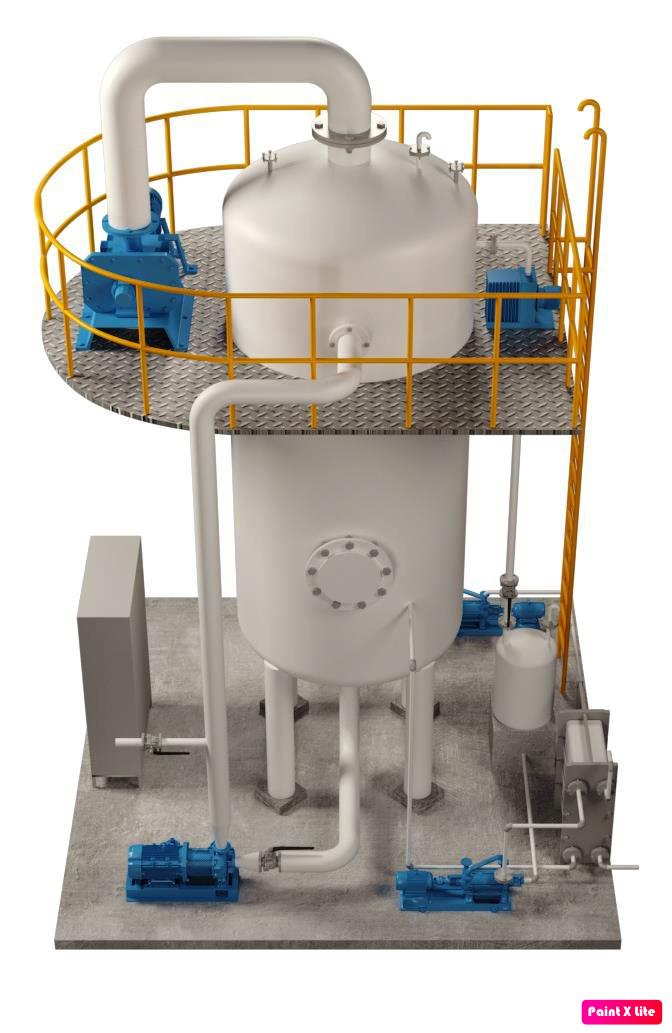
Short Description: UNI-Evap Smart MVR Evaporator The UNI-Evap Smart MVR Evaporator by Unitop Aquacare is an energy-efficient evaporation system designed for wastewater concentration and Zero Liquid Discharge (ZLD) applications. Based on Mechanical Vapor Recompression (MVR) technology, the system operates using electrical energy without the need for external steam or cooling water, significantly reducing operating costs .By applying the “heat pump” principle, the MVR system continuously recovers and reuses latent heat within the process, delivering high thermodynamic efficiency and water recovery of up to 99%. With a compact footprint, low fouling design, and fully automated operation, UNI-Evap Smart MVR is ideal for textile, chemical, pharmaceutical, and industrial effluent treatment applications.
Get a QuoteOperates using steam as the primary heat source
Uses multiple evaporation stages to improve steam economy
Suitable for large volumes and high TDS effluents
Lower capital cost compared to MVR
Proven and robust technology for ZLD systems
Steam consumption optimized through multistage flashing and optional TVR
Best suited for: Plants with available steam and stable effluent characteristics.
Operates using electrical energy only (no external steam required)
Recompresses vapor using a compressor based on the heat pump principle
Very low operating cost due to internal heat recovery
Compact footprint
Water recovery up to 99%
No cooling tower or boiler required
Best suited for: Plants aiming for low energy consumption, automation, and minimal utility dependency.
MEE = Lower CAPEX, steam-based, ideal for high-volume systems
MVR = Higher efficiency, lower OPEX, electrically driven system
Both technologies are critical components of Zero Liquid Discharge (ZLD) solutions, and selection depends on effluent load, utility availability, and long-term operating strategy.